... Capitolo 3 .... La scuola per tutti/Education for all
Aggiornamento: 5 ott
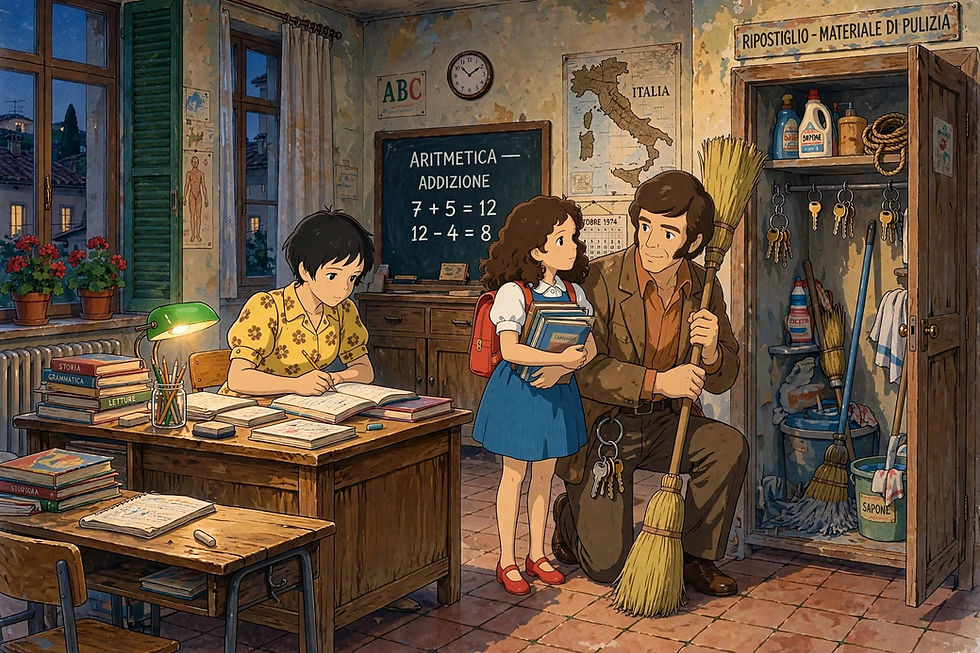
– Anelli smarriti, trecce ribelli e il profumo di rivalsa
I primi due anni delle elementari li avevo passati in un paio di stanze di fortuna recuperate in una casa vicino alla mia. Un’esperienza molto "pionieristica". Poi, finalmente, la svolta: il Comune ci trasferì in un nuovo edificio. Nuovissimo per noi, intendiamoci, perché la struttura in realtà era vecchia come il cucco e avrebbe avuto un gran bisogno di lavori di ristrutturazione pesanti, ma noi eravamo gente di poche pretese e ci facemmo bastare quello che c’era.
Il vero colpo di scena con quel trasloco fu un altro: l'addio definitivo ai grembiuli neri e ai fiocchi rosa e celesti. Le nuove direttive li avevano dichiarati ufficialmente obsoleti. Senza quel kit da perfetto scolaro dell'Ancien Régime, ci sentivamo a nostro modo dei piccoli rivoluzionari, fieri figli di quel comunismo che, nella Campoverde di quegli anni, non era una teoria politica ma la ricetta esatta per la libertà e il riscatto sociale.
Le nuove aule, a dire il vero, erano ancora più austere delle precedenti, ma il look generale non cambiò di una virgola. Sedevamo sempre sui classici banchi biposto in legno — quelli pieni di solchi e graffi incisi dalle generazioni passate — con il mitico forellino circolare fatto apposta per il calamaio dei nostri genitori. Alle pareti, immobili sentinelle del tempo, non mancavano mai il crocifisso di legno e il ritratto ufficiale del Presidente della Repubblica in carica, che ci fissava con un'espressione severissima dall'alto.
In quell'epoca la figura dell’insegnante non si discuteva: era un’autorità assoluta, venerata e temuta dalle famiglie. Noi, però, avevamo pescato il jolly. La nostra maestra si chiamava Gabriella: una signora di mezz’età con una splendida chioma di capelli d'argento e un'infinita dolcezza nei modi. Non usava mai le punizioni, preferendo la parola al rigore. Una mosca bianca: faceva tutto lei, insegnandoci ogni singola materia e accompagnandoci pazientemente giorno dopo giorno.
Nel frattempo, a casa mia soffiava un vento di grandi iniziative. Seguendo il prezioso esempio di mio padre, anche mia madre decise che era arrivato il momento di rimettersi in gioco e prendersi quel benedetto diploma di terza media.
Così, la sera, la nostra utilitaria si metteva in moto: partivamo tutti e tre insieme, trasformandoci in una piccola carovana familiare. La ragione strategica di questo viaggio di gruppo? Evitare assolutamente di lasciarmi a casa da sola con mio fratello, onde sventare disastri di proporzioni bibliche. Il babbo guidava con una diligenza quasi sacrale: lo osservavo dal sedile e capivo che per lui stare attento era la priorità assoluta. Guidare era una cosa seria.
Io, manco a dirlo, adoravo letteralmente quelle serate, di cui oggi conservo un ricordo tenerissimo. La mamma entrava orgogliosa nella sua aula con i quaderni e gli appunti sotto il braccio, fiera di dimostrare a se stessa di essere una brava studentessa. Io, intanto, approfittando di quella spensierata libertà, mi aggiravo felice nelle aule vuote e semibuie dell'istituto, giocando a fare la maestra e scatenandomi con la cimosa e i gessetti colorati sulla lavagna di ardesia.
E il babbo? Nei corridoi, dopo aver consumato in fretta la cena fredda che la mamma gli aveva preparato con cura prima di uscire, imbracciava ramazza e straccio e puliva i pavimenti della scuola.
Un giorno, mentre era intento a passare la scopa tra i banchi di un’aula vuota, scorse qualcosa luccicare per terra. Si chinò e raccolse un anello d’oro: una piccola fede sottile e finemente intarsiata.
«Guarda Leda cosa ho trovato per terra», disse, mostrandomelo sul palmo della sua mano grande. Io sgranai gli occhi di fronte a quel tesoro imprevisto: «Lo teniamo per la mamma?», esclamai piena di speranza.
Mio padre sorrise con dolcezza, scuotendo la testa. Mi spiegò prima di tutto che per la mamma quell'anello era decisamente troppo piccolo — dato che lei aveva mani grandi e un'ossatura robusta — ma, soprattutto, mi impartì una lezione che non potrò mai dimenticare: quell'anello andava restituito, semplicemente perché era la cosa giusta da fare.
«Ho trovato altre cose in passato, Leda, e le ho sempre restituite. Adesso lo porterò in segreteria e vedrai che troveranno a chi appartiene». A guardarlo negli occhi, mi sembrò l’unica scelta logica del mondo. La sua onestà non era una cosa su cui si potesse contrattare.
Di lì a poco, anche mia madre centrò il suo obiettivo e ottenne l'agognato diploma. Per lei fu un riscatto tardivo, ma potente. Da ragazzina gli studi le erano stati negati perché la scuola media distava troppo dal podere; così mia nonna, con grande pragmatismo, l'aveva mandata da una vicina a imparare il mestiere di sarta. Peccato che mia madre avesse un altro grande sogno nel cassetto: diventare parrucchiera.
Un desiderio nato il giorno in cui, stanca dei suoi lunghissimi capelli corvini che la facevano sentire troppo "bambina", aveva preso un paio di forbici robuste e si era tagliata le grosse trecce da sola. La nonna c'era rimasta secca: anni e anni spesi a far crescere quella meravigliosa chioma, e mia madre l'aveva rovinata in un secondo. Si era arrabbiata moltissimo, ma ormai la frittata era fatta. Da quel momento mia madre aveva capito una cosa fondamentale: le piaceva da morire tagliare i capelli e voleva farne il suo lavoro. Ma la nonna era severa e per lei aveva scritto un copione diverso.
Ecco perché, quando stringeva quel pezzo di carta tra le mani, mia madre era letteralmente radiosa: sentiva di essere tornata al timone della propria vita. E fu proprio in quel periodo che capii una grande verità: per i miei genitori era una questione vitale che anche noi figli studiassimo. Per non dover mai, in futuro, permettere a qualcun altro di decidere per noi.
translate:
– Lost Rings, Rebellious Braids, and the Sweet Taste of Redemption I spent my first two years of elementary school in a couple of makeshift rooms carved out of a house near mine. It was a pretty 'pioneering' experience. Then came the big breakthrough: the town council moved us to a new building. Well, 'brand-new' for us, mind you—the structure itself was actually as old as the hills and in dire need of a massive overhaul, but we weren't ones to complain and made do with what we had. The real plot twist of that move, though, was something else: saying a permanent goodbye to the black smocks and the pink and light-blue ribbons. New guidelines had officially declared them obsolete. Stripped of that perfect Old Regime schoolboy uniform, we felt, in our own small way, like little revolutionaries—proud children of that brand of Communism which, in the Campoverde of those years, wasn't a political theory but the exact recipe for freedom and social redemption. The new classrooms, truth be told, were even more austere than the old ones, but the overall look didn't change one bit. We still sat at traditional two-seater wooden desks—the ones covered in grooves and scratches carved by past generations, complete with that iconic little circular hole meant for our parents' inkwells. On the walls, silent sentinels of time, there were always two staples: the wooden crucifix and the official portrait of the sitting President of the Republic, staring sternly down at us from above. Back then, the teacher was an unquestioned figure of absolute authority—revered and feared by families alike. We, however, struck gold. Our teacher was Mrs. Gabriella, a middle-aged woman with a magnificent crown of silver hair and infinitely gentle manners. She never resorted to punishment, preferring reason over strict discipline. A true rarity, she taught us every single subject herself, patiently guiding us day after day. Meanwhile, a wave of bold initiative was blowing through my home. Following my father’s inspiring example, my mother decided it was time to step back into the arena and go after her middle school diploma. And so, every evening, our little family car would rumble to life as all three of us set off together, turning into a tiny family caravan. The strategic reason behind this group trek? To make absolutely sure I wasn't left home alone with my brother, thereby preventing disasters of biblical proportions. My dad drove with almost sacred diligence: watching him from the back seat, I could tell that staying focused was his absolute priority. Driving was serious business. I, naturally, adored those evenings and still cherish a tender memory of them in my soul. Mum would walk proudly into her classroom, notebooks and notes tucked under her arm, eager to prove to herself that she was a good student. Meanwhile, taking full advantage of my newfound freedom, I wandered happily around the empty, dimly lit school halls, playing teacher and going wild with the eraser and colored chalk on the slate blackboard. And Dad? Out in the hallways, after quickly wolfing down the cold dinner Mum had lovingly packed for him before leaving, he’d grab a broom and rag to sweep and mop the floors. One day, as he was busy sweeping between the desks of an empty classroom, he spotted something sparkling on the floor. He bent down and picked up a gold ring—a thin, finely engraved wedding band. 'Look, Leda, what I found on the floor,' he said, showing it to me on the palm of his large hand. My eyes widened at the sight of this unexpected treasure: 'Can we keep it for Mum?' I blurted out, full of hope. My father smiled gently, shaking his head. First, he explained that the ring was far too small for Mum—since she had large hands and a sturdy frame—but above all, he taught me a lesson I’d never forget: the ring had to be returned simply because it was the right thing to do. 'I've found other things in the past, Leda, and I've always returned them. Now I'll take it to the office, and you'll see they'll find who it belongs to.' Looking into his eyes, it struck me as the only logical choice in the world. His honesty wasn't open for negotiation. Before long, my mother hit her mark and earned her hard-won diploma. For her, it was a late but powerful redemption. As a young girl, she had been denied an education because middle school was too far from the farm; so my grandmother, ever pragmatic, had sent her to a neighbor to learn seamstress work, ignoring her big dream of becoming a hairdresser. That dream was born the day she grew tired of her long, raven-black hair—which made her feel too much like a child—and grabbed a pair of heavy scissors to chop off her thick braids herself. My grandmother was horrified: years and years spent growing that gorgeous hair, and my mother had ruined it in a second. She was furious, but the damage was done. From that moment on, my mother realized one fundamental truth: she absolutely loved cutting hair and wanted to make a living out of it. But Grandma was strict and had written a very different script for her. That's why, holding that piece of paper in her hands, my mother was positively radiant: she felt like she was back in the driver's seat of her own life. It was during that time that I understood a profound truth: for my parents, it was a matter of vital importance that their children studied, so we would never have to let anyone else decide our fate for us.
Le 150 ore: quando studiare era un atto di rivoluzione 🛠️📚
Prima metà degli anni ’70. Fabbriche rumorose, mani sporche di grasso, tute blu e turni massacranti. Per un operaio di allora la scuola era un ricordo lontano, abbandonata a dieci anni per andare a lavorare. I libri? Roba da ricchi.
Poi, nel 1973, i sindacati dei metalmeccanici strappano una vittoria storica: 150 ore di permesso retribuito per studiare. Il patto era semplice e potente: 150 ore le pagava l’azienda, 150 ce le mettevi tu nel tuo tempo libero.
Nessuno studiava per fare carriera o per accumulare titoli. Studiavano per emanciparsi. Per capire la propria busta paga, per leggere la Costituzione, per avere le parole giuste con cui dire di "no".
All’improvviso le aule serali si riempirono di uomini e donne con le mani segnate dal lavoro. Niente lezioni frontali, ma sedie in cerchio: la Storia si studiava partendo dalla loro vita, la geografia dalla loro fabbrica. Dalle tute blu, la rivoluzione arrivò presto alle casalinghe e alle giovani madri, trasformandosi nella prima vera occasione di riscatto sociale per tantissimi italiani.
La cultura smetteva di essere un privilegio per pochi e diventava un attrezzo di lavoro. Una chiave inglese, ma per aprire la testa.
💭 Spunti di riflessione per oggi:
Il senso dello studio: In un’epoca dominata da master corsaioli, reskilling continuo e metriche per LinkedIn, usiamo ancora la formazione come strumento di libertà personale o solo come dovere di occupabilità?
Il valore del tempo: Se oggi ti venissero offerte 150 ore pagate da dedicare allo studio, cosa sceglieresti di imparare? Un’abilità utile al tuo lavoro o qualcosa che renda più libera la tua testa?
L'accesso alla cultura: La tecnologia e il web hanno reso l'informazione accessibile a tutti, ma ha davvero colmato il divario culturale o ha solo sostituito i libri con il rumore di fondo?
Tu cosa ne pensi? Inseguiamo la formazione per essere o soltanto per produrre?
Reflective Social Media Post
The 150 Hours: When Studying Was an Act of Revolution 🛠️📚 The first half of the 1970s. Noisy factories, grease-stained hands, blue overalls, and grueling shifts. For a factory worker back then, school was a distant memory, abandoned at age ten to help bring home a paycheck. Books? Something for the privileged. Then, in 1973, the metalworkers' unions secured a historic victory: 150 hours of paid leave for education. The deal was simple yet powerful: 150 hours paid by the company, 150 hours contributed from your own free time. No one studied to climb the corporate ladder or collect credentials. They studied for self-emancipation. To make sense of their paychecks, to read the Constitution, to find the exact words to say 'no.' Suddenly, evening classrooms filled with men and women bearing hands worn by hard labor. No lecture-style classes, but chairs arranged in a circle: history was taught starting from their own lives, geography from their own factory floor. From blue-collar workers, the revolution soon reached housewives and young mothers, turning into the first true opportunity for social redemption for countless Italians. Culture ceased to be a privilege for the few and became a working tool. Like a wrench, but built to open minds. --- 💭 Food for thought today:
• The Purpose of Education: In an era dominated by rushed master's degrees, constant reskilling, and LinkedIn metrics, do we still use education as an instrument of personal freedom, or merely as a requirement for employability?
• The Value of Time: If you were offered 150 paid hours today to dedicate to study, what would you choose to learn? A skill useful for your job, or something that frees your mind?
• Access to Culture: Technology and the internet have made information accessible to everyone, but has it truly bridged the cultural divide, or has it simply replaced books with background noise? What do you think? Do we pursue education to be, or just to produce?


Commenti